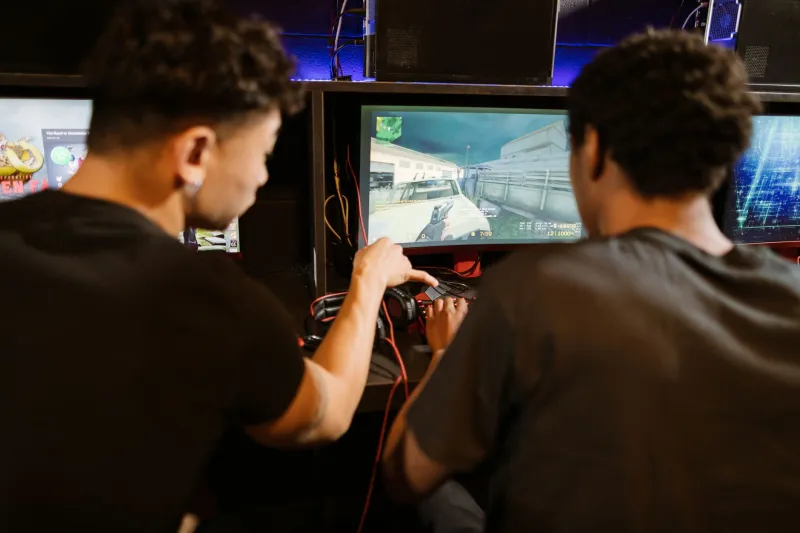
Accessibility Settings Were Built for Some Players — Then They Made Games Better for All of Us

Photo: Evgeny2665, CC0, via Wikimedia Commons
There's a menu screen moment I think about a lot. I was setting up a new game — one of those dense action titles with a million button combos — and I noticed a section labeled "Accessibility." I almost skipped it. I didn't need it, right? Except then I clicked in, turned on an input assist option I'd never tried before, and suddenly the game felt so much better for how I actually play.
That moment stuck with me, because I think it captures something the gaming world is only recently starting to say out loud: accessibility features aren't a niche add-on. They're good game design. Full stop.
What We Even Mean by "Accessibility"
The term covers a pretty wide range of features. At the core, accessibility options exist to make games playable for people whose disabilities would otherwise create barriers — visual impairments, motor limitations, hearing loss, cognitive differences. That's the original and most important purpose, and it's worth saying clearly: these features exist because disabled gamers deserve to play too, and for a long time the industry didn't take that seriously enough.
But the scope of what counts as "accessibility" has expanded. Colorblind modes. Subtitles with speaker labels. Remappable controls. Adjustable text size. Difficulty modifiers. Input assist options. Slow-motion modes during cutscenes. Navigation assistance. The list keeps growing — and so does the number of players quietly using these features for reasons that have nothing to do with disability.
The Colorblind Mode Everyone Uses
Let's start with one of the most widespread examples. Colorblind modes were added to games to help players who struggle to distinguish certain color combinations — red-green colorblindness affects roughly 8% of men in the US alone, so this is far from a rare need.
But ask around in any gaming community and you'll find players without colorblind conditions who turn on colorblind mode because it makes the UI cleaner, the enemy highlights more visible, or the map easier to read in a bright room. The feature works. It solves a visual clarity problem for everyone, not just the people it was designed for.
Games like Hades, Celeste, and Fortnite have gotten specific praise for how thoughtfully they implemented color options. It's not just a filter slapped on top — the palettes are actually designed to be functional.
Subtitles Changed How People Watch Games
Subtitles are one of those accessibility features that have become almost universal, and the reasons people use them are all over the map. Deaf and hard-of-hearing players need them. Non-native English speakers rely on them. Players gaming in shared spaces without headphones use them. People who just process written information better than audio use them.
The industry push for better subtitles — with speaker identification, font size options, and background contrast — came directly from accessibility advocacy. And the result is that everyone's experience of story-driven games improved. You're less likely to miss a critical plot line because your roommate was watching TV in the next room.
The Last of Us Part I and God of War: Ragnarök both got significant attention for their subtitle systems, and not just from accessibility-focused outlets. General gaming media noticed that the implementation was genuinely thoughtful in a way that elevated the whole experience.
Remappable Controls Are a Bigger Deal Than They Sound
This one doesn't get enough credit. The ability to remap controller buttons or keyboard keys started as a feature for players with motor disabilities who couldn't comfortably reach certain inputs. And it remains critical for that reason.
But remappable controls also matter for left-handed players, for people who learned a different control scheme on an older game and can't unlearn it, for streamers who want specific layouts that work better on camera, and for players who just have strong preferences about where their jump button lives. It's one of those features that once you have it, you can't believe it was ever missing.
The console-level accessibility features that both PlayStation and Xbox have invested in over the past few years — including full system-level button remapping — reflect how seriously platform holders are starting to take this. And the ripple effect on the broader player base has been real.
Difficulty Customization: The Most Controversial Good Idea
Okay, this is where it gets spicy, because difficulty has historically been a culture war in gaming spaces. The "git gud" crowd has not always been welcoming toward games that offer flexible challenge options.
But here's what actually happened when developers started building robust difficulty customization: more people played their games, finished them, talked about them, and recommended them. Celeste — one of the most brutally challenging platformers in recent memory — introduced an "Assist Mode" that lets players adjust game speed, add invincibility, or skip chapters. The developer's framing was explicit: this doesn't make the game easier for people who don't use it. It makes the game accessible to people who would otherwise be locked out entirely.
The result? Celeste is beloved across the entire spectrum of player skill. Hardcore players who never touched Assist Mode praise it. Players who needed it to finish the game praise it. The community is bigger and warmer because of it.
Similar stories play out with Sekiro's third-party accessibility mods (which FromSoftware eventually acknowledged with some grace), and with games like Disco Elysium that let you essentially tune the challenge to your preferred experience.
What This Means for the Gaming Community
There's a community angle here that I think is worth naming directly. When games are more accessible, the player base grows. When the player base grows, communities get more diverse — in age, background, ability, and perspective. That diversity makes gaming communities richer and more interesting.
Streaming culture has actually accelerated this in a cool way. Streamers who play on lower difficulties or use assist modes have normalized those choices for their audiences. Watching someone use colorblind mode on stream and seeing it work better than the default has probably converted a lot of viewers. Accessibility features that might have felt "not for me" become visibly useful when you see them in action.
This is how design improvements spread. Not through marketing, but through players showing other players.
The Bigger Picture
None of this is an argument to stop centering disabled gamers in conversations about accessibility. They're the reason these features exist, and they're the people who most need the industry to keep improving. The point isn't "accessibility is actually for everyone" in a way that erases that.
The point is that good, inclusive design has a way of raising the floor for everybody. When developers are forced to think carefully about how all kinds of players interact with their game, they make better games. Clearer interfaces. More flexible controls. Smarter difficulty curves. These aren't compromises — they're upgrades.
And if you've been sleeping on the accessibility menu? Go poke around in there. You might be surprised what you've been missing.